Akuamma
What Is Akuamma? A Plant, Its Seeds, and Their Opioid-Active Alkaloids
If you’ve come across akuamma while researching kratom alternatives, botanical pain remedies, or novel opioids derived from natural products, you’ve probably noticed something: clear, honest information is hard to find. The marketing often races ahead of the science, and the science itself is still catching up to centuries of traditional knowledge. This guide breaks down…

If you’ve come across akuamma while researching kratom alternatives, botanical pain remedies, or novel opioids derived from natural products, you’ve probably noticed something: clear, honest information is hard to find. The marketing often races ahead of the science, and the science itself is still catching up to centuries of traditional knowledge.
This guide breaks down what akuamma actually is, what’s inside the seed, how its alkaloids interact with the body, and where the research genuinely stands as of 2026. No hype, no miracle claims-just the details you need to make informed decisions.
Key Takeaways
-
Akuamma refers to the dried seeds of Picralima nitida, a West African tree used in traditional medicine for centuries to treat pain, fever, and gastrointestinal disorders. It is not a single synthetic drug.
-
The seeds contain several indole alkaloids-including akuammine, pseudo-akuammigine, akuammicine, and akuammidine-that can affect mu and kappa opioid receptors, but far more weakly than prescription opioids or kratom alkaloids like mitragynine.
-
Akuamma’s analgesic effects are minimal in animal models, and no large-scale regulated clinical trials have established safe or effective dosing in humans for pain relief, kratom withdrawal, or addiction treatment.
-
Modified akuamma alkaloids created in labs have shown dramatically increased potency (up to 70-fold at the mu opioid receptor), but these compounds are not found in natural seeds or commercial supplements.
-
Explore the Poppy & Lotus botanical guides and current product selection for more context on traditional and emerging plant allies, always grounded in what the evidence actually supports.
What Is Akuamma? (Quick Answer)
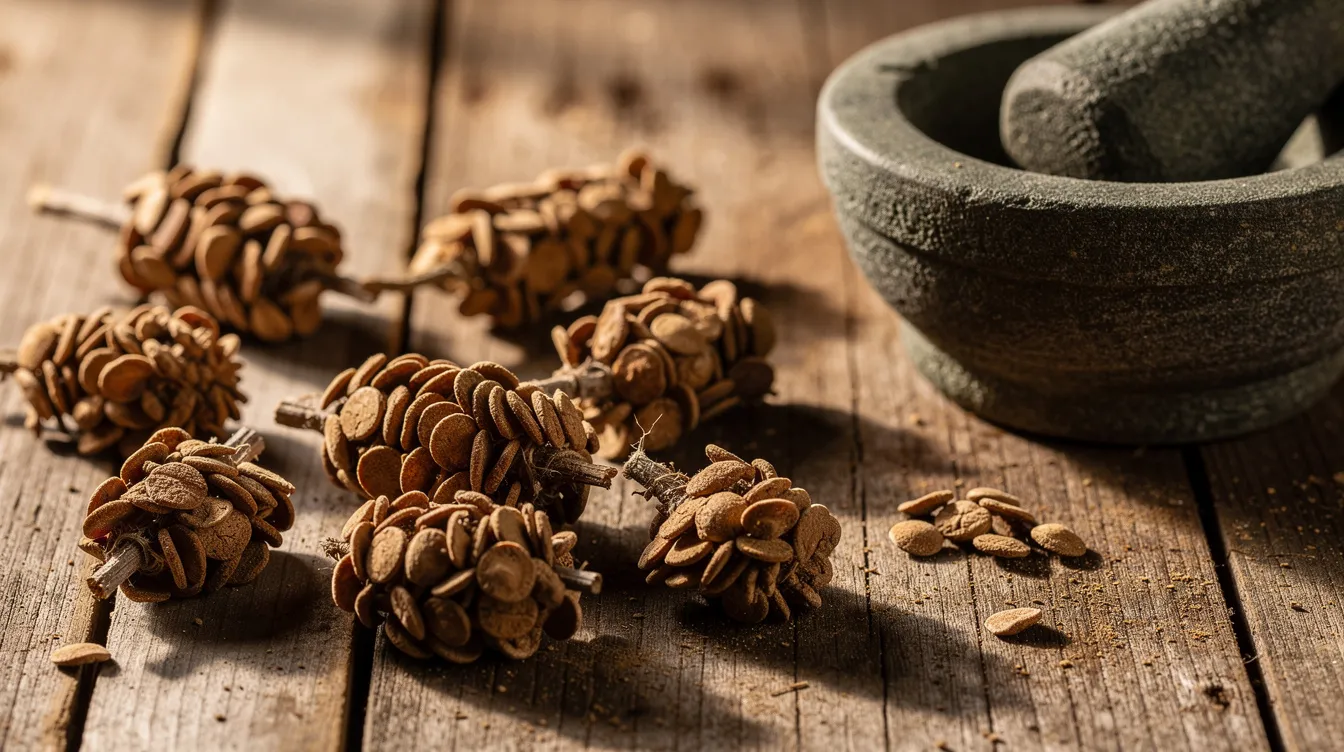
Akuamma is the common name for the dried seeds of Picralima nitida (sometimes written as P. nitida), an evergreen tree native to countries like Ghana, Nigeria, and Côte d’Ivoire in West Africa. If someone hands you an akuamma product, you’re almost certainly looking at ground seed powder, whole dried seeds, or capsules-not a pharmaceutical compound.
The dried akuamma seed has a long history of traditional use for pain, fever, and digestive complaints, often ground and swallowed in small doses. The bitter seeds are typically taken in capsule form due to their intense bitterness. Modern interest comes from the akuamma alkaloids inside the seed, which can interact with the mu opioid receptor and kappa opioid receptors but are considerably weaker than classical opioid analgesics. In shops or online, “akuamma” usually means powdered seeds, capsules, or crude extracts rather than isolated pharmaceutical-grade alkaloids.
Botanical Background: The Akuamma Tree (Picralima nitida)
Picralima nitida is a small to medium evergreen tree in the Apocynaceae (dogbane) family, with glossy, elliptic leaves and a canopy adapted to tropical lowland forests. It is native to West and Central Africa, growing naturally across Ghana, Nigeria, Cameroon, Côte d’Ivoire, and surrounding regions.

The tree produces large, greenish-yellow fruits with thick rinds. Inside, flat brown akuamma seeds are embedded in fibrous pulp. Traditional harvesting practices involve collecting ripe fruits, removing the seeds, cleaning them, and sun-drying before use or sale in local markets.
In ethnobotanical literature, “akuamma” can refer to either the tree or its medicinal seeds, but in commerce the term almost always means the seed material itself. Akuamma seeds have been used for centuries in traditional medicine across these regions-a point worth keeping in mind when evaluating modern marketing claims.
What Is Inside an Akuamma Seed?
An akuamma seed is a complex plant matrix, not a single compound. It contains fats, fiber, flavonoids, polyphenols, saponins, and-most importantly for pharmacology-multiple alkaloids.
The major alkaloids typically reported include:
-
Akuammine – the most abundant alkaloid in most seed samples
-
Akuammidine
-
Pseudo-akuammigine
-
Akuammicine
-
Picraline
-
Akuammiline
These are collectively called akuamma alkaloids. All are classified as indole alkaloids (specifically monoterpene indole alkaloids), but they differ from each other in structure, receptor targets, and pharmacological properties. The seeds contain a unique profile of alkaloids including akuammine. Total alkaloid content is often reported around 4–5% of dried seed weight.
Seed composition varies with growing region, age of the plant, harvest timing, and processing method-so two batches of akuamma seed powder may not have identical alkaloid profiles. Most consumer products deliver this whole mixture, not a standardized single-alkaloid dose.
Akuamma vs. Individual Akuamma Alkaloids
Here’s a distinction that matters more than most people realize: “akuamma” in commerce usually means whole or minimally processed seed, whereas “akuamma alkaloids” in a research paper are purified chemicals tested at precise, known concentrations.
-
In scientific articles, compounds like akuammine, akuammidine, and pseudo-akuammigine are weighed and tested individually at known concentrations-often micromolar levels in receptor assays-against specific receptor subtypes.
-
When someone swallows an akuamma seed capsule, they ingest a variable mixture of several alkaloids plus other plant constituents, which can change how each alkaloid is absorbed and metabolized.
-
This difference explains why measurable mu opioid receptor activity in a petri dish does not automatically translate into strong, predictable pain relief from a teaspoon of seed powder.
Keep the “whole plant vs. isolated compound” difference in mind whenever you encounter marketing claims or lab research headlines about akuamma.
How Do Akuamma Alkaloids Affect Opioid Receptors?
Your body has several types of opioid receptors-proteins on nerve cells that respond to both your own internal painkillers (endorphins) and external substances. The three major types are:
|
Receptor |
Primary Role |
Key Association |
|---|---|---|
|
Mu (μOR) |
Pain relief, reward, respiratory depression |
Target of morphine, fentanyl, mitragynine |
|
Kappa (κOR) |
Analgesia, stress, dysphoria |
Linked to aversive effects |
|
Delta (δOR) |
Mood modulation |
Less understood, involved in emotional processing |
How do akuamma alkaloids affect opioid receptors? Several akuamma alkaloids can bind to the mu opioid receptor-the same primary target as many prescription opioids and kratom alkaloids. Akuammine and akuammidine are weak μ opioid receptor agonists, with binding affinities in the low micromolar range (Ki around 0.5 µM). Akuammicine, by contrast, shows the highest binding affinity for kappa opioid receptors (~0.17 µM), with meaningful selectivity for that subtype.
Functional assays reveal that these molecules often act as a partial agonist at the mu receptor and show minimal β-arrestin recruitment-a pattern sometimes described as signaling bias. This is significant because biased agonists that preferentially activate G protein pathways over β-arrestin pathways are theoretically associated with fewer side effects like respiratory depression. The alkaloids exhibit unique signaling properties that set them apart from classical opioids.
However, measurable receptor activity does not equal real-world analgesic effects. In animal models, natural akuamma alkaloids often show weak or inconsistent pain reduction even at higher doses-a theme we’ll return to below.
What Does Modern Research Say About Akuamma?
Recent work (roughly 2020–2025) has focused on isolating akuamma alkaloids and characterizing how they interact with central nervous system receptors. A study isolated six akuamma alkaloids for pharmacological evaluation using advanced purification techniques like pH-zone-refining countercurrent chromatography applied to commercial akuamma seed powder.
This detailed characterization involved screening across more than 40 brain receptors. The results identified mu and kappa opioid receptors-along with certain dopamine receptors-as primary binding sites for several alkaloids. The pharmacological characterization confirmed that akuamma alkaloids interact with opioid receptors in the human body, but the in vivo picture is more complicated.
In mouse studies-including the tail flick assay and hot-plate tests-natural alkaloids often showed weak or inconsistent pain relief at doses that would be very high by human standards. Akuamma’s analgesic effects are minimal in animal models at practical doses. Research also indicates that akuamma may possess anti-inflammatory properties, and akuamma has been documented as having antimalarial activity in laboratory studies.
There are still no large, controlled human clinical trials assessing clinical pain relief, mood effects, or long-term safety of akuamma seed products. Limited clinical studies exist on the safety and efficacy of akuamma in humans. This makes akuamma an investigational botanical rather than an established medicinal treatment.
Modified Akuamma Alkaloids and Increased Potency
Medicinal chemistry sometimes involves “tuning” naturally occurring molecules to see if researchers can improve their potency or selectivity at a target receptor. That’s exactly what happened with akuamma alkaloids.
In 2023-era work, researchers created 22 semi-synthetic derivatives of pseudo-akuammigine and related compounds. By adding a phenethyl group at a specific nitrogen position (N1), they produced a semi-synthetic derivative-labeled “compound 33”-that showed roughly a 70-fold increase in potency at mu opioid receptors compared to the parent alkaloid in vitro, along with about 7-fold increased selectivity for μOR over κOR. One modified akuamma alkaloid showed a 70-fold increase in potency at mu-opioid receptors. That’s a massive jump from distinct scaffolds that started with modest activity.
In mouse models, this compound approached morphine-like analgesia in the tail flick assay at very different doses (ED₅₀ ~77 mg/kg subcutaneously vs. 10 mg/kg for morphine). Effects were blocked by naloxone, confirming opioid preferring activity through the expected receptor pathways.
These modified akuamma alkaloids with increased potency are not present in natural akuamma seeds and are not available as over-the-counter supplements. They are research tools-part of an ongoing effort to find safer opioid analgesics with features like reduced respiratory depression or improved signaling bias. Whether such compounds ever reach clinical use is an open question with significant regulatory implications. A methyl ester group and other structural elements play roles in the structure-activity relationships being explored.
Is Akuamma an Opioid? Clarifying a Common Question
Akuamma is not a prescription opioid medication and not a single synthetic opioid drug. It is a botanical product-dried seeds from a tree.
That said, akuamma seeds contain compounds that act on the mu opioid receptor and kappa opioid receptors, so their pharmacology overlaps with opioids even though the source material is botanical. The opioid receptor activity is real and measurable. Akuamma seeds interact with opioid receptors in the human body, but the distinction between “having opioid activity” and “being an opioid” matters.
In regulatory terms, “opioid” usually refers to drugs derived from or modeled on the opium poppy-like morphine, oxycodone, fentanyl-not indole alkaloids from trees like Picralima nitida. Some people loosely call akuamma an “opioid-like herb,” but this is a simplification that doesn’t reflect formal drug scheduling or medical approval. Akuamma is not classified alongside other opioids or traditional opioids.
Treat akuamma seriously, like any substance with opioid receptor activity, even if it’s sold as a natural product. The label “herbal” does not override pharmacology.
Akuamma Versus Kratom: Similarities and Differences
Many people discover akuamma while searching for kratom alternatives or botanical alternatives to prescription opioids, particularly on forums discussing the opioid crisis and non prescription alternatives.
Here’s how they compare:
|
Feature |
Akuamma |
Kratom |
|---|---|---|
|
Source plant |
Picralima nitida (Apocynaceae) |
Mitragyna speciosa (Rubiaceae) |
|
Origin |
West Africa |
Southeast Asia |
|
Key alkaloids |
Akuammine, pseudo-akuammigine, akuammicine |
Mitragynine, 7-hydroxymitragynine, mitragynine pseudoindoxyl |
|
μOR activity |
Weak (micromolar Ki) |
Stronger (nanomolar to low micromolar) |
|
Subjective intensity |
Generally mild |
More pronounced |
|
Dependence data |
Very limited |
Well-documented |
Akuamma alkaloids interact with mu-opioid receptors but with lower potency than kratom. The opioid receptor activity of akuamma is consistently weaker than kratom’s in both binding assays and behavioral effects reported by users. Kratom alkaloids like mitragynine and 7-hydroxymitragynine show stronger receptor activation and more pronounced subjective effects in human users.
Dependence, tolerance, and kratom withdrawal are well documented for kratom. Addiction potential for akuamma is much less studied, so cross-substitution between the two is not evidence-based. Both involve psychoactive drugs derived from natural products, but their pharmacological profiles are meaningfully different.

Why Are People Exploring Akuamma as a Kratom Alternative?
Regulatory scrutiny, personal concerns about kratom dependence, and curiosity about other plant allies have led some individuals to explore akuamma for pain relief or to ease opioid withdrawal symptoms. Akuamma is considered a potential alternative for managing pain in some Western herbal communities.
Common reasons people cite include:
-
Hoping for gentler effects with fewer negative consequences
-
Avoiding stronger kratom alkaloids
-
Curiosity about different botanicals that might affect opioid receptors
-
Trying to manage chronic pain with varied approaches to pain management
Survey data suggest that many akuamma users have a history of kratom use, indicating a perceived overlap in purpose. But marketing sometimes outpaces evidence-claims of kratom withdrawal support or addiction treatment are not yet backed by clinical research.
If you’re considering such a transition, especially for kratom withdrawal or opioid withdrawal, consulting a healthcare professional is far safer than relying solely on self-directed botanical experiments. Medical detox programs and evidence-based treatments exist for a reason.
Is Akuamma Addictive? What We Know and Don’t Know
Any substance affecting mu opioid receptors raises reasonable questions about underlying dependence and withdrawal. So is akuamma addictive?
Here’s what we know:
-
No participants in a U.S. survey met criteria for akuamma-related substance use disorder.
-
Insufficient human data exists to determine akuamma’s addiction potential with confidence.
-
Weaker opioid receptor activity and lower subjective intensity may imply that akuamma may produce lower dependence potential than traditional opioids, but this has not been definitively proven.
-
Some alkaloids in akuamma may exhibit sedative effects, adding another variable.
Behavioral warning signs that could indicate a developing problem-even with “herbal” products-include:
-
Escalating doses over time
-
Continued use despite harm
-
Craving or preoccupation with the next dose
-
Difficulty stopping or cutting back
If you notice loss of control with akuamma or any other opioid-active herb, seek professional assessment. The fact that something is sold as a botanical does not eliminate the possibility of dependence.
Can Akuamma Help With Kratom Withdrawal or Addiction Treatment?
As of now, there is no established clinical protocol using akuamma for kratom withdrawal or formal addiction treatment. No clinical evidence supports akuamma for opioid withdrawal treatment.
Anecdotal reports online describe people taking akuamma during kratom tapering or opioid withdrawal, but these are uncontrolled, self-experimentation stories with no way to separate placebo effects, dose variability, or concurrent factors. Replacing one opioid-active herb with another-when dosing and potency are unknown-can complicate withdrawal timelines and mask, rather than resolve, dependence.
Medications with solid evidence for opioid use disorder-such as buprenorphine or methadone-have been studied extensively in controlled trials. Akuamma has not. Its therapeutic utility for addiction treatment remains speculative.
If akuamma is used at all in this context, it should be approached cautiously, alongside medical guidance, rather than as a stand-alone addiction treatment. Disease control and harm reduction work best when grounded in evidence, not hope.
How Do People Traditionally Use Akuamma Seeds?
Akuamma has been sold in West African markets since at least the late 19th and early 20th centuries as a household remedy. Traditional uses of akuamma include treating malaria symptoms and gastrointestinal issues, alongside general pain and fever. Akuamma seeds are primarily used for pain management and fever reduction in their regions of origin.
Common traditional preparations include:
-
Swallowing a single dried seed whole
-
Grinding the seed into a bitter powder mixed with water or honey
-
Incorporating it into simple tonics or herbal formulations
Traditional indications cover headaches, toothache, generalized pain, fever, diarrhea, and other gastrointestinal disorders. Doses are traditionally small and intermittent, guided by local experience rather than standardized mg/kg measurements.
In Ghana, for instance, “Picap” capsules containing ground seed (~250 mg per capsule) are marketed locally for pain relief and diarrhea-an example of traditional knowledge meeting more formalized packaging.
Traditional use in a cultural context does not automatically validate modern high-dose, daily supplement patterns seen in online communities.
Modern Forms of Akuamma on the Market
Contemporary products include whole seeds, ground akuamma seed powder, capsules, tinctures, and various extracts sold globally via the internet. Akuamma is commonly sold as whole dried seeds or capsules in modern herbal markets.
A few things to watch for:
-
“Standardized extract” labels may refer to a specified percentage of total alkaloids but often don’t list exact amounts of individual components (e.g., how much akuammine vs. akuammidine vs. other alkaloids).
-
Some products are blended with other botanicals-sometimes kratom or kava-which changes the overall pharmacology and safety profile.
-
Lab testing, certificates of analysis, and transparent sourcing help reduce risks of contamination or mislabeled potency.
As a botanical-focused brand, Poppy & Lotus prioritizes education, careful sourcing, and clarity around what plant parts and preparations are-and are not-used. If you’re navigating botanical products, understanding what’s actually in the bottle matters more than the label’s promises. The Relax Remedy approach and similar product lines emphasize this transparency.
Pharmacokinetics: How the Body Handles Akuamma Alkaloids
Pharmacokinetics describes how a substance is absorbed, distributed, metabolized, and excreted by the body. For akuamma, this story explains a lot about why strong receptor binding in a lab doesn’t always translate to strong effects after oral dosing.
Key findings from recent animal studies:
-
Several akuamma alkaloids show good intestinal permeability in cell monolayer models, but when given orally as ground seed suspension to rats, systemic exposure was significant only for akuammine.
-
Akuammine has an oral bioavailability of 12.0% in rats-meaning roughly 88% of what’s swallowed never makes it to the bloodstream intact.
-
In rat liver microsome assays, akuammine had a half-life of only ~13.5 minutes, and akuammiline ~30.3 minutes. Metabolism is rapid; first-pass effects are substantial.
-
Pseudo-akuammigine shows high plasma protein binding, which can limit the free concentration available to reach target receptors.
-
Akuamma alkaloids showed varying degrees of metabolic stability across compounds.
-
Akuamma alkaloids have low oral bioavailability in rats as a general pattern.
These kinetic quirks help explain why high oral doses in animals sometimes produce only modest behavioral effects despite decent receptor activity in vitro. Human pharmacokinetics remain largely uncharacterized, so extrapolating exact dose-effect relationships from animal data is speculative.
Why Opioid Receptor Activity Does Not Guarantee Strong Pain Relief
Binding to the mu opioid receptor is only the first step in a long chain leading to real-world pain relief. Effective analgesics must:
-
Reach adequate concentrations in the right tissues
-
Stay there for a sufficient time
-
Trigger the right patterns of receptor signaling-not just attach to the receptor
In mouse tail flick and hot-plate tests, natural akuamma alkaloids often show weak or inconsistent antinociception even at relatively high doses. One study found pseudo-akuammigine was about 3.5 times less potent than morphine in comparable analgesic assays. Akuamma’s alkaloids interact with opioid receptors but lack strong analgesic effects in practice.
Signaling bias-limited β-arrestin recruitment combined with mixed activity at kappa opioid receptors-may further differentiate subjective effects from classic opioids. This is interesting for developing novel opioids with fewer side effects, but it also means akuamma seeds don’t reliably treat pain the way conventional medications do.
Akuamma has not been proven safe for treating chronic pain. It should not be considered a proven substitute for evidence-based pain medications, especially for severe or chronic pain conditions.
Potential Risks, Side Effects, and Interactions
“Natural” does not mean “risk-free,” especially for botanicals that affect opioid receptors.
Commonly reported side effects (from anecdotal and limited survey data):
-
Nausea
-
Dizziness
-
Fatigue and sedation
-
Gastrointestinal upset, particularly at higher doses
Interaction risks:
There are concerns regarding interactions of akuamma with central nervous system depressants. Combining akuamma with alcohol, benzodiazepines, prescription opioids, barbiturates, or strong sleep medications could increase sedation or respiratory risk. The fact that some akuamma alkaloids share metabolic pathways with common drugs raises additional interaction concerns.
Other unknowns include possible liver effects with long-term use, unknown contaminants or adulterants in poorly regulated products, and the absence of established safe dosing guidelines. Some alkaloids may exhibit sedative effects that compound the risk when combined with other opioid medications.
If you have medical conditions, are pregnant, or currently take prescription opioids or other prescription medications, consult a healthcare provider before experimenting with akuamma seeds or extracts.
Legal and Regulatory Status
Laws change, and you should always check current local regulations before purchasing or using any psychoactive botanical or other psychoactive drugs.
As of the mid-2020s:
-
Akuamma is generally sold as a dietary or ethnobotanical product in many countries and is not scheduled like classical opioids in most jurisdictions.
-
There is no FDA-approved drug product based on akuamma seeds or akuamma alkaloids for pain, kratom withdrawal, or addiction treatment in the United States.
-
Modified akuamma alkaloids with increased potency might eventually attract regulatory attention if such compounds move toward clinical drug development.
-
Akuamma has not undergone large-scale regulated clinical trials for standardized dosing.
Distinguish between legally sold plant materials and experimental semi-synthetic derivatives, which remain laboratory-only substances. The gap between “legal to sell” and “proven safe and effective” is enormous-and with akuamma, it has not been bridged. Text and data mining of research databases continues to expand what we know, but the clinical evidence remains thin. Similar technologies for analyzing botanical composition are also evolving but not yet standard in the supplement market.
How Poppy & Lotus Approaches Botanicals Like Akuamma
The Poppy & Lotus blog focuses on clear, evidence-informed education about traditional botanicals and their modern uses and limitations. The goal is not to sell you on miracle cures but to give you the context you need to make thoughtful decisions.
Poppy & Lotus values:
-
Prioritizing plant identity, part of plant, origin, and preparation method so readers understand exactly what they’re reading about or considering
-
Separating what’s supported by evidence from what’s speculative or anecdotal
-
Encouraging integration of botanicals with-not as replacements for-appropriate medical care
Explore Poppy & Lotus’s other botanical guides-covering topics from kratom alkaloids to poppy-derived medicines to non-opioid herbs that support comfort and resilience. Whether you’re interested in data mining the latest research or simply want a grounded overview, the blog is a good starting point.
Choosing and Using Botanicals Responsibly
Herbs like akuamma exist in a grey area between traditional medicine, modern pharmacology, and wellness marketing. That grey area requires extra care.
Practical harm-reduction strategies:
-
Start low: Begin with very small doses and increase cautiously if needed
-
Avoid combinations: Don’t mix with other sedatives, other opioids, or alcohol
-
Keep records: Maintain a usage journal tracking dose, timing, and effects
-
Pause when needed: Stop use immediately if adverse effects appear
-
Talk to your doctor: Be open about all botanicals you use, even if they’re not formally prescribed
View botanicals as one tool among many-alongside sleep, nutrition, movement, psychotherapy, and conventional medicine-rather than as magic bullets. Opioid related deaths in the United States underscore why caution with any opioid-active substance, including natural products, is warranted. The opioid crisis has taught us that even well-intentioned pain management can carry serious negative consequences when substances are used without adequate oversight.
Continue learning through the Poppy & Lotus blog, newsletters, and educational resources for plant science and safe, grounded practice.

Frequently Asked Questions About Akuamma
Is akuamma stronger than kratom?
Available evidence suggests akuamma is generally less potent than kratom in terms of opioid-like effects and subjective intensity. No robust, head-to-head human clinical trials exist, but user reports and receptor pharmacology both point to kratom alkaloids as the stronger group. Akuamma’s opioid receptor activity is weaker than kratom’s across multiple measures.
Keep in mind that variability in product strength-for both kratom and akuamma-makes individual experiences hard to predict. A weak batch of kratom might feel comparable to a strong batch of akuamma, but on average, kratom produces more noticeable effects.
Does akuamma contain kratom alkaloids like mitragynine or 7-hydroxymitragynine?
No. Akuamma seeds do not naturally contain mitragynine, 7-hydroxymitragynine, mitragynine pseudoindoxyl, or other major kratom alkaloids. The primary active compounds in akuamma are structurally distinct indole alkaloids such as akuammine and pseudo-akuammigine. Only laboratory testing can confirm whether a specific commercial product has been adulterated or blended with kratom.
Can akuamma show up on a drug test?
Standard workplace drug screens typically target opioids like morphine, oxycodone, and synthetic opioids-not akuamma alkaloids, which have entirely different chemical structures. Specialized toxicology tests could, in theory, detect akuamma alkaloids, but they are not part of routine panels at this time. If you work in a safety-sensitive job or face legal scrutiny, avoid experimenting with little-studied botanicals without understanding your testing policies.
How long do akuamma effects last?
Typical anecdotal timelines suggest onset within about 30–90 minutes when taken orally, with mild effects that may last a few hours. Duration likely depends on dose, product type (seed vs. extract), and individual metabolism. Formal human studies are lacking. Because data are sparse, avoid redosing quickly and monitor your own responses carefully.
Is akuamma safe to combine with other herbs or medications?
Safety of combinations has not been systematically studied, and interactions are possible-especially with other sedatives or opioid-active substances. Examples of substances that may increase risk when combined with akuamma include alcohol, benzodiazepines, prescription opioids, barbiturates, and strong sleep medications. Consult a healthcare professional and err on the side of simplicity-fewer substances at once-when working with potent botanicals.